


NZ Curriculum Updates - June 2026

As you will be aware, there is a new national curriculum being rolled out nationwide.
In 2026, the English and Maths curriculums have been finalised, and our staff are in the process of adapting their teaching and learning programmes to deliver them.
Other curriculum areas are being released periodically in draft form.
You can watch a video about the changes here.
Levels → Phases
The new curriculum is not in levels anymore, but phases. Year 7&8 are in Phase 3, while Year 9&10 are in Phase 4. Year 11-13 are Phase 5.
Within each phase there are specific year-level targets students are expected to meet. The new curriculum expects all students in a year level to be taught or exposed to material at their level.
What’s the difference?
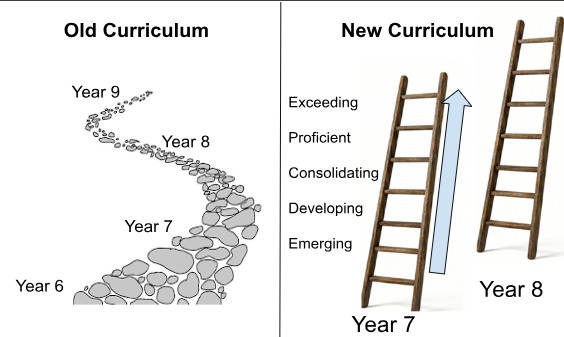
The old levelled curriculum was like a pathway - students progressed along the pathway or levels at their own pace. The new curriculum is like a series of ladders. Each year level has its own ladder. Students climb the ladder for their year level and at the end of the year move onto the next ladder.
Reporting
To assess students, teachers will be expected to make a judgement about each student’s progress on the ladder in the middle and at the end of the year using one of 5 descriptors: Emerging, Developing, Consolidating, Proficient and Exceeding. By the end of each year, students are expected to be Proficient for their year level.
You will begin to see report grades and comments which reflect the new curriculum and use the new progress descriptors.
In this period of changeover, you will continue to see other reporting in the form of Not Achieved, Achieved, Merit, Excellence (for academic results) or Developing, Meeting Expectations, Showing Strength (for attributes, skills or competencies).
Has my child gone backwards?
You may find that your child, who you thought was progressing well with their learning, is shown as ‘Developing’ or ‘Consolidating’ against the new curriculum. Please be reassured that your child has not suddenly fallen behind or lost a huge amount of learning.
Their results may look different for a range of reasons:
- The new curriculum is pitched higher than the old one. For some students, this means their learning was expected to ‘jump’ the gap from the old curriculum level to the new higher level in no time. The old levels spanned multiple years where the new one has strict progress markers for each year.
- Descriptors mean different things at the middle of the year and the end of the year. E.g. Consolidating in the middle of the year means ‘on track to meet expectations,’ but Consolidating at the end of the year means ‘not yet meeting expectations.’
- Some gaps have been exposed. The old curriculum allowed for more flexibility. For example, strong creative writing with gaps in punctuation or structure could receive a decent overall result; the new curriculum has specific targets for students to achieve, and they must be meeting the majority of them for their year level. The positive of this is clarity around next steps for teaching and learning.
- ‘Proficient’ means they are where they should be at the end of the year. It means a student has fully mastered the rigorous expectations for their year level and is totally ready for the next year’s learning challenges. Therefore, working towards that throughout the year is to be expected.

Further information:
Curriculum Phases: https://newzealandcurriculum.tahurangi.education.govt.nz/new-zealand-curriculum-online/new-zealand-curriculum/phases-years/5637165576
General reporting information: https://newzealandcurriculum.tahurangi.education.govt.nz/reporting-to-parents-and-wh-nau/5637158852
Progress Descriptors: https://www.education.govt.nz/parents-and-caregivers/schools-year-0-13/parent-portal/guide-your-childs-reporting-and-progress#progress-descriptors-1
Maths:
